by Dr. Stephen Phua
September 10, 2026
What Makes Healthcare Innovation Investable in Asia and how a regional strategic alliance among countries leveraging on the strength of each other to accelerate and reduce costs of global translational innovative health tech assets to meet desperate unmet medical needs in the world?
The Executive Hook: Moving from “Interesting Science” to “Investable Assets”
Is great science enough to guarantee a successful investment?
In the current Asian healthcare landscape, the answer is a resounding “no.”
Our region is home to an abundance of world-class research. Yet we face a persistent “Valley of Death.” This is the financing gap where promising discovery fails to become a validated asset.
As investors, we do not fund “interesting science.” We fund de-risked, commercializable assets.
The scarcity isn’t in the biology—it’s in the execution. To thrive, we must move from being consumers of innovation to creators of global value.
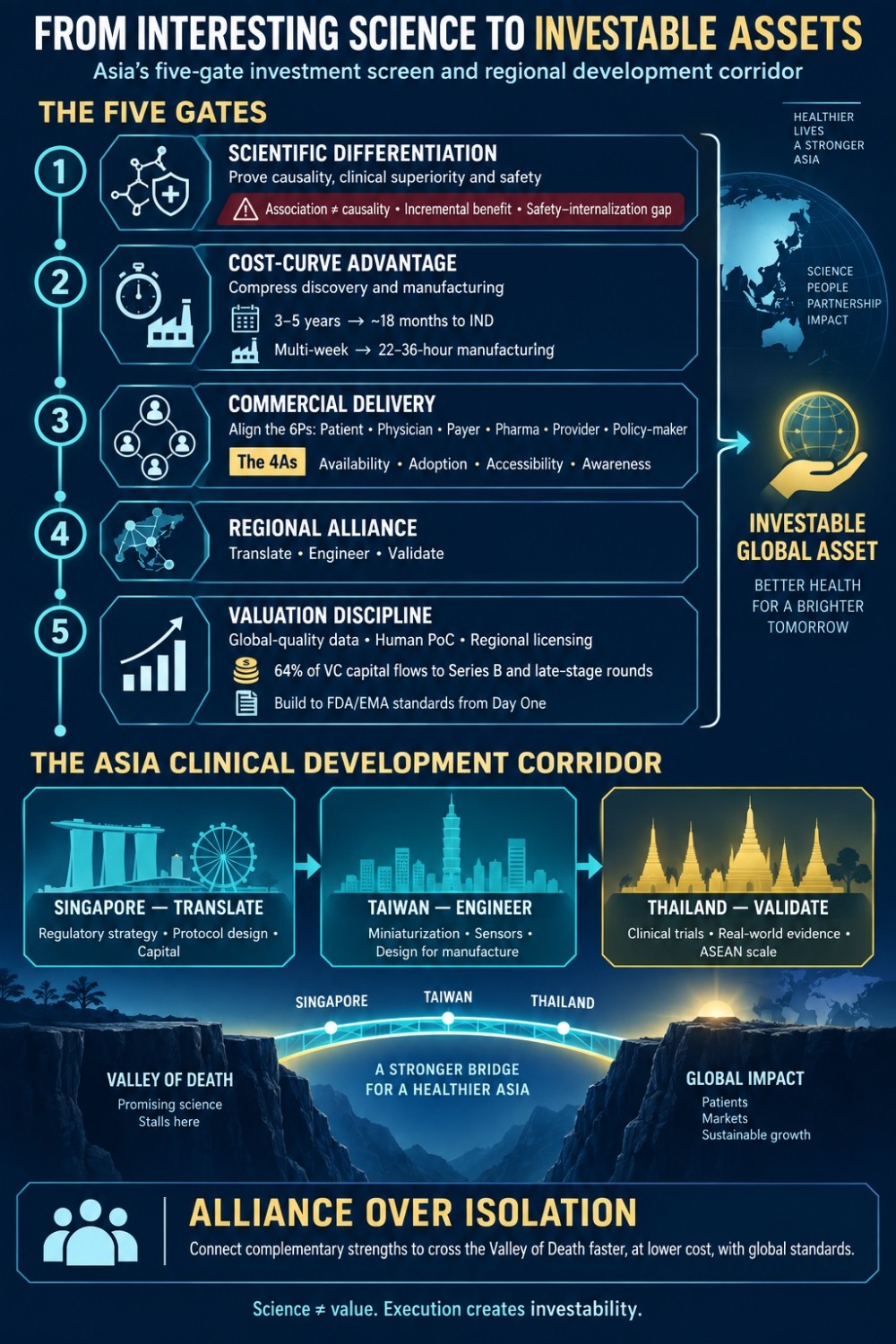
Gate 1: The Scientific Litmus Test (Differentiation vs. Incrementalism)
Investors must distinguish between a breakthrough and a laboratory curiosity. A common pitfall is the “Better Metric Fallacy,” where superior laboratory data fails to translate into clinical superiority.
Consider our “Thai Precision Oncology” case study. A novel Antibody-Drug Conjugate (ADC) might show a of 0.2 nM—a 7.5x higher binding affinity than the Phase III competitor at 1.5 nM. On paper, it looks like a winner. However, if the internalization rate is 40% slower, the payload never reaches its target.
Furthermore, if non-human primate studies reveal a liver toxicity signal, you don’t have an asset—you have a regulatory bottleneck. True differentiation requires a clear Mechanism of Action (MOA) that overcomes the standard of care.
Three Scientific Red Flags for Investors:
- Lack of Causality: The data shows a biological association rather than a proven causal link between target and disease.
- Uncertain Clinical Differentiation: The innovation offers incremental improvements that cannot overcome high clinical switching costs.
- The Safety-Internalization Gap: Superior binding is neutralized by poor tissue penetration or narrow therapeutic windows in non-human primates.
Gate 2: Bending the Healthcare Cost Curve (Efficiency as a Moat)
To be investable in Asia’s price-sensitive markets, innovation must shatter the “Double-Ten” rule (10 years, $1B+ development). Efficiency is no longer just a metric; it is a primary competitive moat.
We focus on two major levers for “Discovery & CMC Efficiency”:
- Discovery Compression: AI engines like Insilico Medicine’s Pharma.AI have moved lead candidates to IND in ~18 months, cutting the traditional 3–5 year window in half.
- CMC Innovation: Manufacturing must move closer to the patient. Gracell’s FasTCAR “Next-Day Manufacturing” (22–36 hour processing) is a paradigm shift that drastically lowers the Total Cost of Treatment (TCOT).
The Asia Innovation Pathway

Gate 3: Commercial Reality & Outcomes-Based Delivery (The 4As & 6Ps)
Fragmented Asian markets require a shift from “fee-for-service” to “outcome-based” models. Adoption depends on aligning the 6Ps: the Patient, Physician, Payer, Pharma, Provider, and Policy-maker.
To ensure the Internal Rate of Return (IRR) for high-cost Advanced Therapies (ATMPs), we utilize the 4As Framework:
- Availability (Right-Siting): Moving care from acute hospital beds to “Hospital-at-Home” models. This drives a 200% improvement in bed capacity by shifting longitudinal management to the community.
- Adoption (Lab Readiness): Equipping community labs for CGT administration so that specialized treatment isn’t restricted to a few urban centers.
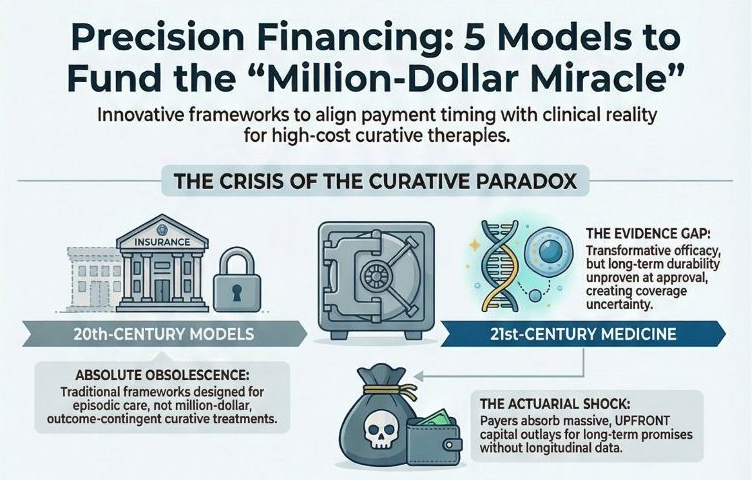
- Accessibility (Precision Financing): Moving beyond one-off payments to the FoCUS model—performance-based annuities where payments are contingent on long-term efficacy. This is a mandatory structural evolution to de-risk high-cost cures for payers.
- Awareness (Outcome-Based Tools): Using home diagnostics to shift from reactive treatment to proactive prevention.
Gate 4: The Regional Alliance Model (The Singapore-Taiwan-Thailand Corridor)
Asia’s edge does not lie in duplicating Western clusters country-by-country. It lies in the “Translate-Engineer-Validate” model, connecting three specific powerhouses into a single Clinical Development Corridor.
- Singapore (TRANSLATE): The de-risking engine. With a S$2.5B MOH commitment to translational research, Singapore provides the regulatory quality, protocol design, and capital to move science out of the lab.
- Taiwan (ENGINEER): The industrialization hub. Leveraging a NT$210B medical-device industry, Taiwan excels in precision engineering, sensors (e.g., ITRI Heart Guardian), and robotics to make prototypes scalable.
- Thailand (VALIDATE): The scale-up gateway. Thailand provides the ATMP One-Stop Service for regulatory acceleration, massive patient access for clinical trials, and a launchpad into the ASEAN market.
The Clinical Development Corridor Contribution:
- Singapore: Translation, regulatory strategy, and regional headquarters.
- Taiwan: Miniaturization, sensor integration, and design-for-manufacture.
- Thailand: Clinical-trial execution, real-world evidence, and local manufacturing.
Gate 5: Valuation Discipline & Strategic Deal Architecture
We are witnessing a global “flight to quality.” Series B and late-stage rounds now absorb 64% of VC capital, as investors demand clinical data over platform narratives. The Asian region is no longer a location for lower cost manufacturing; more first-in-class and best-in-class innovations meeting unmet global medical needs are emerging from the region.
Simultaneously, an “Out-licensing Boom” is underway, with 39% of US “biobucks” deal value flowing into Chinese-originated assets like ADCs. However, the US BIOSECURE Act has raised the stakes for geopolitical risk. To avoid a “Valuation Discount,” Asian startups must:
- Design for Global Data Integrity: All preclinical data must meet FDA/EMA standards from Day One. In the BIOSECURE era, data transparency is the only way to remain a viable M&A target.
- Prioritize PoC: Focus capital on reaching a human Proof-of-Concept (PoC) endpoint rather than broad platform expansion.
- Leverage Regional Licensing: Use regional rights to generate non-dilutive capital to fix mechanistic or toxicity flaws before seeking a global exit.
7. Conclusion: From Consumers to Creators
The opportunity for Asia is not to reproduce Boston or San Francisco. It is to build the world’s most connected development ecosystem. By linking Singapore’s translation, Taiwan’s engineering, and Thailand’s clinical scale, we can reduce development time and improve capital efficiency.
The next phase of biotechnology will be won by the region that connects its assets most effectively.
Key Takeaways
- Science Value: High binding affinity is irrelevant without clinical differentiation and safety proven in primate models.
- Efficiency is the Moat: AI discovery and CMC innovation (like FasTCAR) are the primary levers to optimize the Total Cost of Treatment.
- Alliance over Isolation: Use the “Translate-Engineer-Validate” corridor to avoid duplicating infrastructure.
- Global Standards: Build to international regulatory rigor from the start to mitigate geopolitical risks and capture global M&A interest.
Final Call to Action: Which regional synergy do you believe is currently the most undervalued in the Singapore-Taiwan-Thailand corridor? Let’s discuss in the comments.
Conclusion:
Is your science an “investable asset” or just a “research project”?
In the high-stakes world of APAC life sciences, the gap between a breakthrough and a payout is wider than ever. We are seeing a massive flight to quality, where 64% of VC capital now demands late-stage clinical proof. Could the Asia Regional Alliance fill the capital gap in the critical value-inflection but highly risky “valley of death” development for biotech and medtech startups with game-changing solutions to unmet global medical needs?
I’ve outlined the five “Gates” that healthcare innovations must pass to be truly investable in today’s market—from the binding affinity fallacy to the rise of the Singapore-Taiwan-Thailand translational funding and clinical corridor. If you are interested in the entire content of the panel discussion, please add “interested” in your comment and I will send you the details
#HealthcareInnovation #VentureCapital #BiotechAsia #MedTech #LifeSciences #HealthEquity #AsiaPacificBusiness #ClinicalTrials #BIOSECUREAct